Two classic lesbian novels were published in the 1980s, and were also filmed. One was initially called The Price of Salt and was actually written by Patricia Highsmith who also wrote mainstream thrillers. The book was republished in 1984 under the name of Claire Morgan.
The film made about this novel was renamed Carol and some changes were made about Carol’s partner Therese, making her a photographer rather than a theatrical set designer.
In the book, Carol lost custody of her daughter as her husband had employed a private detective who found out that she was having a lesbian relationship with her young lover Therese. The book actually reflected the lives of many lesbian mothers who were losing custody of their children in the UK. Carol was originally devasted by the loss of her daughter. However, in the end she decided to set up her own business and she and Therese ended up living together. The book is excellently written and is a must read for younger lesbians.
The other classic book that involved a lesbian relationship was the Color Purpl’ by Alice Walker which was published in 1983. It won the Pulitzer Prize. Celie, one of the main characters in the book, discovers the love and support of women with Shug Avery, a singer. This book was also made into a wonderful film about black women’s experiences in the early 20th century. It was however resented by black men who did not like the way that they were portrayed. Brilliantly written, it is another must read for younger lesbians.
Much more recently there has been a revival of historic films which include lesbian relationships. One is the film Ammonite based on the story of Mary Anning, the discoverer of fossils in Dorset. It stars Kate Winslet who has a romantic lesbian relationship with the geologist Charlotte Murchison. Another is a French film called Portrait of a lady on fire’ and is set in the 18th century. It tells the story of a lesbian relationship between a young woman aristocrat and a lesbian painter.
”Grace and Marigold’ was launched by Elaine Hutton and Lynne Harne — long-term UK-based lesbian activists currently running the Lesbian Rights Alliance and the Lesbian History Group. This launch took place online on on 27 August 2024. The following is a description of the book, which is published by Spinifex Press. You can watch the launch by clicking the link at the end of the description.
It’s 1974 when 20-year-old Grace arrives in London determined to shrug off her Australian past and reinvent herself. While embracing her new life in the Free Republic of Beltonia, a street of communal squats, she’s haunted by the unbearable thought that she might be a lesbian – a fate she considers almost worse than death. Before long, she falls (secretly) in love with Marigold, upper class, enigmatic and avowedly straight. When Marigold mysteriously disappears without a trace, the search for her leads Grace to a life-changing epiphany.
Evoking the spirit of 1970s London through the world of squatting and political protests, street parties, encounter groups and gurus, and the mayhem of a rackety publishing outfit where Grace gets a job, Grace and Marigoldis both witty and moving in its exploration of the inner turmoil, and ultimate liberation of a young woman’s journey to self-acceptance.
Mira Robertson’s debut novel, The Unexpected Education of Emily Dean was published in 2018. Her short stories have won prizes and have appeared in various literary magazines and journals. Her screenwriting credits, written with director Ana Kokkinos, include the award-winning films Only the Brave and Head On. Mira lives in Melbourne.
Saturday, March 2nd, 2024 In this session we will discuss lesbian fiction drawn from different categories.
Coming Out stories – Elaine Hutton will talk about some Coming Out stories, their significance, and how they evolved over time as the Women’s Liberation Movement took hold. e.g. All That False Instruction, 1975, by Kerryn Higgs/Elizabeth Riley; Rubyfruit Jungle, 1973, by Rita Mae Brown; Relatively Norma, 1985, by Anna Livia.
Lynne Harne will talk about twolesbian thrillers which challenge the stereotypes of femininity, Hen’s Teeth, 1996, and Stronger than Death, 1999, by Manda Scott.
Coming Out Stories
Rubyfruit Jungle, 1973, and All That False Instruction, 1975, are similar in some ways and very different in others. Both are first novels, young women looking back on their lives from very early childhood to early adulthood. They are both written on the brink of the Women’s Liberation Movement, when neither character had any support for their position, so it’s left to the reader to imagine how they will develop. But the first person perspective in both makes their stories very personal and we feel we’re sharing their experiences.
Rubyfruit Jungle Molly Bolt is a lively, non-conforming youngster from the beginning. At the age of 11, she proclaims ‘I don’t care whether [people] like me or not. Everybody’s stupid, that’s what I think. I care if I like me, that’s what I truly care about.’(p 31) she tells her cousin Leroy and she maintains this confidence throughout the book. She discovers sex with girls early on, aged 11, and goes on to many more encounters, all positive. She grows up energetic and rough, handy with her fists, and rejects femininity in clothing and female roles, and, to the despair of her adoptive mother Carrie, refuses to know her place. She reminds me of Scout in To Kill a Mockingbird.
She’s not immune to social pressures however, but rises above them. Leroy has been her childhood companion, and they’ve had sex together. ‘Leroy never did get to be an accomplished kisser’, she discovers early, but as she starts to excel academically, ‘Leroy was getting more and more like any other redneck. It got to the point where he thought he owned me, just because we’d do it every now and then’. When she can ride his new motorbike better than he can he ‘tells her to shove off and that she’s ‘really a dyke’. (p 64)
In 1970, Rita Mae Brown was part of the group of women, the Radicalesbians, who staged a demonstration at the NOW conference which had excluded lesbians from the programme. They cut the lights, then turned them on to reveal the lesbians scattered throughout the audience, wearing Lavender Menace purple t-shirts, waving posters proclaiming : “TAKE A LESBIAN TO LUNCH!” “SUPERDYKE LOVES YOU!” “THE WOMEN’S MOVEMENT IS A LESBIAN PLOT!” . The group then distributed a 10-page, collectively written manifesto entitled “The Woman-Identified Woman,” with its famous opening line, “A lesbian is the rage of all women condensed to the point of explosion.”
Brown then co-founded The Furies, a lesbian feminist separatist commune, and it was against this background that Rubyfruit Jungle was eventually published in 1973, after being turned down by major publishing houses, by a small independent feminist press, Daughters Inc. run by oil heiress June Arnold (author of Sister Gin)
Brown’s active lesbian background translates into fictional form to some extent with this novel. Men, when they feature, do not come out well, shown to be intellectually inferior and no good in bed, and potentially dangerous. On sex with men – ‘…they all work the same show. Some are better at it than others but it’s boring once you know what women are like.’ (p 174)
And the film that drew the most applause on their project night ‘was a gang rape…with half the cast dressed as Martians , the other half, as humans. All the men mumbled about what a profound racial statement it was.’ (p 213). And ‘the guy who made the Martian rape went right into CBS as an assistant director for a children’s program. CBS was full up, they told me.’ (p 215) [when Molly applied for a job after graduation].
Isolation and difficulty for lesbians also features. Her friendship threesome with two other women at high school implodes when she gets together with one of them. Molly ends up furiously rejecting them both because of their reactions. Carolyn denies she’s a lesbian, as she’s ‘very feminine’, unlike Molly, Connie announces that she can’t be Molly’s friend anymore as she’d ‘be nervous and wonder if you’re going to rape me or something’. (p 94)
All that False Instruction. This was published first under a pseudonym, Elizabeth Riley. Kerryn Higgs, her actual name, wrote a chapter in Not Dead Yet, 2021, Origins, where she stated:
I grew up in the homophobic Australia of the 1950s – .. It had me subdued, even though it had not compelled me to marry and begin a life of regret and remorse. Though the counterculture gave a certain amount of relief, … before the Women’s Movement I lived in a state of suppressed fear.
This, in a way, is a summary of the novel, though the self-deprecatory, colloquial and lively language belies that description.
Like Rubyfruit Jungle, this novel is a fictional portrayal of feminist theory at the time – the realisation that the 1960s weren’t freedom for women, the discovery of the clitoral orgasm – she discovers it by accident, when a lover’s nipple brushes her clitoris, (p 75); the critique of male behaviour. What is really interesting is that Kerryn Higgs came to these realisations on her own, though in the three years before the book was finally published she inserted an end scene about the women’s movement which was just taking off. More of this later.
Maureen Craig’s upbringing is not dissimilar to Molly Bolt’s, except that she is isolated and unloved (except for her Grandmother) in her turbulent and confrontational rural family, where her authoritarian mother favours her younger brother, Ken, blaming and punishing her for his misdeeds. Like Molly, she escapes by excelling academically. Unlike Molly, Maureen’s lesbian encounters at university are at first awkward, fumbling, embarrassed (p 47), ‘floral pyjamas and huge breasts under flannelette’ (p 46), and terrified of being found out, but her last relationship is emotionally and physically liberating. However, with no WLM to sustain them, lesbianism is seen as unacceptable, dirty, slimy…the other young women she encounters all believe firmly, like Molly’s friend Carolyn, that ‘they’ll need men in the end.’
The novel’s strength is that it charts unflinchingly, with humour at times and frustration and sadness at others, Maureen’s journey towards being herself, and her never giving up hope that she’ll find a loving lesbian relationship, despite betrayals, setbacks, and ostracism. The limitations of Melbourne life are laid bare, in that we see Maureen escaping femininity in the only way available to her, as did other educated young Australian women, entering the masculine world, drinking heavily every night, hanging out with the blokes, swearing (p 199). She buys an old Holden and learns to service it, rejecting male help, and with her German friend Inga, (who is very critical of Australian men) gets a job on boats, abalone fishing at Mallacoota.
She has a series of encounters with men, in an effort to ‘get used to heterosexuality,’ and become normal. However, it is here her critique of patriarchy is most scathing, as well as comic, as she describes male behaviour. In all her encounters with men, Maureen remains detached and silently critical, and increasingly furious, as the men fulfil their own needs, and ignore hers. The writing is explicit – ‘Throat paralysed, as he moves, inwards like a cannonball, jarring guts’ (p 206); ‘Just lie against me, I want to say. It’s not all over for me. Let me come. Don’t leave this anger to breed. …If only he saw that I have needs like his own’…(p 230)
Unlike Rita Mae Brown, Kerryn Higgs was not a feminist activist. She won a fellowship to write her novel – on the basis of the first two chapters. She wrote most of it while in London in 1971-2, delivered the manuscript to Angus & Robertson, and returned to Melbourne. When she had left Australia she had had no contact with feminism at all, and observes that when she read The Female Eunuch in 1972, she was struck how similar Greer’s themes were to her own, though she adds, unlike herself, GG was aware of her context while she was not.
In her 2 years in London, she came across feminists, and when she returned home, remained involved. That is when she added (at editorial stage) an incident where she meets an American ‘out and proud’ lesbian feminist, Jody, who informs her that she lives in a women’s household, and that lesbianism isn’t only about sex, but politics. The words resonate with Maureen, though she doesn’t understand their significance at that point.
She showed ATFI (still unpublished) to her new friends, ‘who subjected it to a feminist fine toothcomb, where any reference that might be interpreted as anti-woman was identified and pointed out to me.’
In September, 1974, she showed the proofs (very late in the day) to her parents. Her mother was very upset, cried for 24 hours, and threatened to sue if it was published, as she saw herself as Lotty. Whether the character was based on her mother we don’t know.
After frantic negotiations with the publisher, the novel was published under the name Elizabeth Riley and was re-sited from Melbourne to Sydney. A&R were unable to publicise or launch with the author, who now admits she was relieved as ‘I had been imprinted, as was Maureen Craig, with the torture of other people’s ostracism and scorn.’ So although the book sank into obscurity, at the time it was noticed and reviewed, and had a large readership by word of mouth from the new active WLM. Finally, an American author found it by chance second-hand in 1989, and promoted it, met Kerryn by writing to Spinifex who put them in touch, and it finally led it to being reprinted. The information above is in the Spinifex reprint.
Relatively Norma Nearly 10 years later, and well into the WLM, we are shown a very different kind of Coming Out. Minnie has gone to Perth, Western Australia, to visit her family, but she is already, unlike the characters in the first two novels, an established lesbian feminist. Her attempts to Come Out to her mother are comic, especially as her mother is obviously aware she’s a lesbian before she arrives, though she hopes she might become heterosexual, or ‘normal’ –
Beryl was thinking how nice it was to have little Minnie home again and why didn’t she stay in Perth and marry a tame Aussie. Perhaps if she introduced her to lovely John from work…(p 18)
But Beryl escapes motherhood and servitude at the end, making a public speech demanding Mother’s Liberation. Her daughters are left bereft ‘But mum, you can’t divorce your children.’
Beryl was soaring into the air. -Minnie fixes me with her honesty, and confesses like The Ancient Mariner at every Opportunity: she’s gay. I’m pleased for her, I’m happy for her, but when I went away the whole day, she didn’t even notice I’d gone. Beryl was zooming up to the ceiling. -…I’m handing in my resignation, I’m nobody’s mother any more. (p 177)
So this is a whole different take on mothers, as Beryl is not discontented, bullying and sniping, but intent on having A Life of Her Own.
Relevance today Brown and Higgs use their character’s mother’s marriages to point out the limitations of heterosexuality and femininity. The daughters reject their mothers’ values, rebel, and are ultimately rejected, especially when their lesbianism becomes known. But Relatively Norma was published when there were thriving lesbian/feminist publishing houses. Also, we were no longer on the cusp of feminism. Consciousness raising groups, and discussion among feminists, were common, and many women, as a result, had developed more sympathy for their mothers, and roles they had been forced into. It is notable that the first two novels, before the input of feminism, brought in sympathy for their mothers at the end. Kerryn Higgs does say she added the reconciliation with her mother at the editorial stage, ‘Maureen experiences a certain understanding for her mother…during 1973, in the new era of consciousness raising.’ And Molly Bolt makes a film of her mother talking about her life, for her final project at film school. Anna Livia goes further, in assigning Minnie’s mother a pivotal role in her novel, where she is not a drudge, or an upholder of heterosexual norms, but is determined to find herself and have a life of her own.
Rubyfruit Jungle is relevant today, in that it is funny, defiant, non-conforming – the heroine is fully self-determining from the very beginning. ATFI is relevant in another way. It is quite remarkable how Higgs writes the sex scenes with women – not pornographic, not romanticised, but very true to life in a way that resonates with lesbian experience. It’s clear also that friendship and intellectual stimulation is an integral part of the relationships. And her encounters with men echo what women were exploring – the lack of satisfaction with sex, the way men ignored women’s needs, how women were reticent about putting their own desires forward. She provides for us a stark contrast between heterosexual and lesbian sex. (Some male critics hated the book and talked of the feminist mafia when it was first published). It is also relevant in showing how a conformist society, without the presence of feminism, exerts such a powerful straightjacket on young women who aspire to be different, and in many cases, wrecks their lives or stops them from becoming fully themselves. Shades of today, and why it’s so important to get to young women and stop the grooming into the transgender cult. The novel is, in turn, funny, sad, anger making, but mainly, truthful of lesbian experience, and I highly recommend it.
In second wave lesbian feminism there were a number of novels published in what was then known as ‘detective fiction’. Most of these books were written by US writers, such as ‘Murder at the ‘Nightwood Bar’ (l987) by Katherine V Forrest, and ‘She Came in a Flash’ (1988) by Mary Wings. In the UK there were some early detective novels written by Val McDermid whose main character was an investigative journalist working in Glasgow.
However, more recently lesbian thrillers have achieved fame and awards. These are books written by Manda Scott and include ‘Hen’s Teeth’ and ‘Stronger than Death.’ Hen’s Teeth was first published in l996 by Women’s Press and then in 2005 by Headline in paperback. Stronger than Death was published in 1999 by Headline.
Some background on Manda Scott. Manda Scott trained as a Vet and originally lived in Glasgow. However, in both of these books she demonstrates a good understanding of being a hospital medic. She was also a mountain climber and her knowledge of mountain climbing is reflected in each book. Hen’s Teeth was shortlisted for the Orange Prize and Stronger than Death for an Arts Council Prize in English Literature. They are really brilliantly written and one of the main factors about them is that they represent a lesbian community set in Glasgow where being lesbian is seen as normal. They also reflect a strong lesbian network where most of the lesbians know each other.
The 2 main characters in both these books are Kellen Stewart and Lee Anderson. They are trained medics at the Glasgow Westenr Hospital although Kellen has re-trained as a psycho therapist. Lee Anderson works in pathology and undertakes post mortems. Kellen, herself is a part owner of a farm near Glasgow that she purchased with her ex-lover, Bridget where they kept horses and provided horse rides. This farm serves as one of the main settings.
Another key aspect of these books is that they do not turn to men for help as they are skilled in manual trades. For example, they are able to change locks and undertake their own building work, where necessary.
Both are focused on finding out about the murders. These include the murder of Bridget, Kellen’s ex-lover in Hen’s Teeth, as well as that of Bridget’s brother, who had his own lab and was a scientist. In the second novel Stronger than Death, there is a series of murders and Lee, herself becomes a police suspect. But neither Lee nor Kellen trust the police and are set on identifying the murderers themselves. Their skills in rock climbing come in useful in resolving the murders.
Lesbian fiction flourished in the 1970s to early 1990s, due to the proliferation of feminist publishers. Onlywomen Press, run entirely by lesbians, started in 1974. The Press operated with a collective, of which I was a member for a short time. Virago started in 1973, followed by Women’s Press, 1978, and Sheba in 1980.
The Camden Lesbian Project was started in the early 1980s. The aim was to have a centre for lesbians only. When it was finally created together with the Black Lesbian Group, it became the only centre for lesbians in the whole country.
It managed to obtain funding for the centre from Camden Council and had a management committee which was multi-ethnic and included lesbians with disabilities. It provided a safe space for lesbians from many different backgrounds to meet up and enjoy lesbian gatherings.
These included holding fund raising events for different projects (then known as benefits) and organising protests and lesbian strength marches
In this talk Diana Souhami outlines the lives of mainly wealthy North American and English lesbians who chose to escape to live in Paris in order to free themselves from the patriarchal control exerted on them by their families at home.
She discusses their support for the new modernist movement in writing and art.
Presentation for Lesbian History Group, Sat 2 November 2019by Zayeet and Vole
Za:Hi I’m zayeet. I’ve been known by many other names over the years but Zayeet will do for now. And…
Vole: I’m Vole, also a bit of a shape-shifter namewise. Previously known as Val Dykestein, currently known as Vole, or on stage as Dr Vole.
Za: We are part of Keep Earth Company which we’ll fill you in on later.
We’re here to talk a bit about lesbian feminist theatre, in an introductory, hopefully pique-your-interest kind of way, and to mostly tell you about what we’ve contributed to the genre.
I came to the UK in 1984. At that time I was doing an MA in theatre, which included playwriting, performing etc. But I already had a background in performance.
In the early 1970s I wrote, directed and played in a musical about lesbians who lived on women’s land, which was a fairly big movement at that time amongst certain women primarily in North America. A few years later I became a member of a lesbian feminist street theatre or guerrilla theatre, bit of both: Auntie Nuke and the Atom Sisters. We performed at demonstrations, in shopping centres, festivals and at feminist venues around the San Francisco Bay area. We had an amazing time parodying the patriarchy, covering various current political concerns.
I also performed in a comedy duo called Friends of Anemone and I did a lot of solo shows composed of skits and original songs. Our themes were always women centred, nature-celebrating, antitechnology, anticapitalism.
When I came to London, one thing I was interested in was learning a diversity of theatre modalities, internationally based. I went to performances and workshops of women from various countries, including studying for a bit with Anu Kapoor from whom I learned a style of theatre called ram-lila from South India. Associated with my MA, I gathered a motley collective of fabulous dykes who became Free Range Women. Together we devised Sprouts Came First which was partially based on that style of theatre.
Lezzannanas was another theatre collective I was involved with into the 1990s with Camilla Cancantata. One of our high points was performing at Lesbenwoche in Berlin. I also was a director of a community arts project, Artshare South-West, which included producing performances and workshops in all sorts of artforms.
Val and I did some one-off shows together – the Meshuggeneh Matzo Show, at the launch of a Jewish women’s night at Wesley House. And West Fried Story – a sketch we did with Camilla at Centerprise as a benefit for PSC (Palestine Solidarity Campaign).
You’ll hear more about Free Range Women and about Val soon, but now we thought we’d sing you a song from my early career.
Lesbian Ecstasy
It's not my fate
 to be a straight
 i'm endowed with a lesbian destiny
 there's no doubt about it
 or way not to shout it
 i'm filled up with lesbian ecstasy…

 Squirrels sing it from the treetops
 Gulls squawk it from the waves
 The lizards live it and love it, don't you
 Elephants and their sisters
 Single cell creatures
 do do do do do what lesbians do

 It's not my fault
 if you're named Walt
 and can't share this lesbian energy
 i'd trade it for none
 all us women have fun
 in Amsterdam, Australia and Anglesey

 Squirrels sing it from the treetops
 Gulls squawk it from the waves
 The lizards live it and love it, don't you
 Elephants and their sisters
 Single cell creatures
 do do do do do what lesbians do

 it's not a fact that i must act
 in a manner that pleases the average norm
 my pleasures are earthly
 my spirit is firstly
 connected with women in wild forms

 Squirrels sing it from the treetops
 Gulls squawk it from the waves
 The lizards live it and love it, don't you
 Elephants and our sisters

 Single cell creatures
 do do do do do what lesbians
 ooh ooh ooh ooh ooh what lesbians
 do do do do do what lesbians do!
Vole, about myself:
I grew up in Hendon in a Jewish family. My parents loved music, books, comedy, theatre, opera, films – as members of the audience. I loved those things too but never imagined that I could become an actor, or even a singer. I put myself in a box marked “writer”, and sat in my room reading and writing. I did a degree in Male Studies – also known as English Literature – but towards the end of it I suddenly had a lightbulb moment of radicalisation.
Eventually I started meeting lesbian feminists. I now realise how amazingly lucky I was to come out into that welcoming world of lesbian feminist politics and culture in the early 80s. I got involved in groups like WAVAW (women against violence against women) and Jewish Lesbians Fight Racism, and I spent all my time at AWP (A Woman’s Place) on the Embankment.
One day this woman – Zayeet – invited me to be part of her theatre group. I’d already started reading my poems in public. I was in Michele Roberts’ writing class at the City Lit. There was a rural residential weekend where we were doing the planning to put on our own poetry event, and someone overheard me singing in the bathroom. Since it was a case of “make your own entertainment”, she persuaded me to sing for the others that evening. I didn’t take a lot of persuading!
That was it – I was launched. So joining up with Free Range Women and putting on our play Sprouts Came First in 1986 was the best thing that had ever happened to me.
We’ll talk about the play itself later. First we’ll sing another of Zayeet’s songs. It’s from her play Fiddler in The Closet…
If there were no rich men
 If there were no rich men
 yayadeyadeyadeyadeyadeyadeya dum
 All day long we’d dykey dykey doo
 If there were no white straight men!

 We wouldn’t have imperialism
 capi crappy zapitalism ku klux klan conservative
 If there were more trees instead of men
 More women-only space and women’s time

 We need a world of wild turkeys and geese
 The end of the family and war
 x-mas gone, and with it the shopping malls
 There would be no more people starving in the streets
 Plenty of borshch to go around
 And lots of feminist vegan matzo balls -
 yayadeyadeya (etc)

 If there were just women
 baleboostah bube meisa bubeleh babushka hoo-ha!
 No more gods and slavery and hate
 Everywhere we’d wildly celebrate
 Would there be too much revelry and mirth -
 If this were a lesbian earth?
Zayeet: Dyke theatre list Some earlier theatre that led up to or were precursors to lesbian feminist theatre as we knew it in the 80s include:
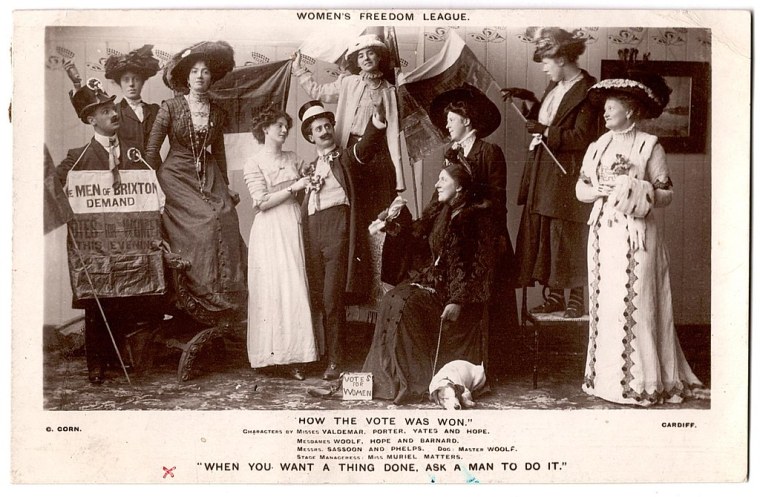
Suffrage drama of which there was quite a bit. Amongst the better-known plays were How the vote was won by Cicely Hamilton as well as Votes for women by Elizabeth Robbins, which appeared at the Royal Court in 1907 – it was a more feminist version of Hedda Gabler. Edith Craig (daughter of Ellen Terry) set up the Pioneer Players (1911-20) She and her partner Christabel Marshall wrote plays for the actresses’ franchise league.
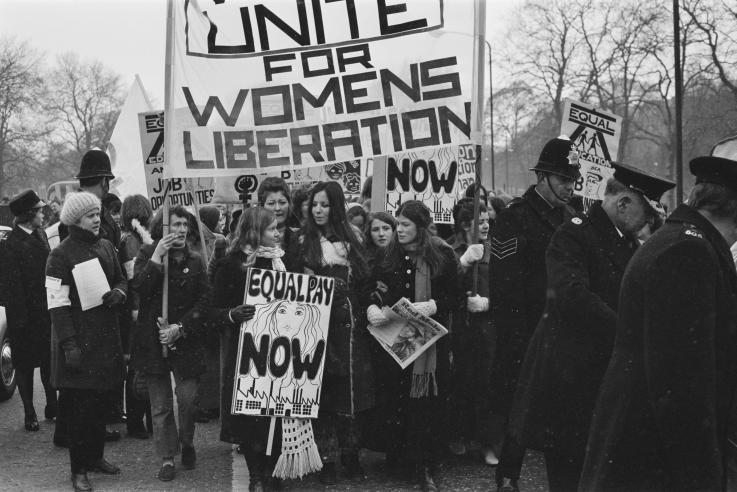
Women’s Liberation March
Then of course from the 60s a major influence was theatricality of political uprisings and marches including those to do with lesbian and gay rights, women’s liberation et cetera.
Women’s Theatre Group
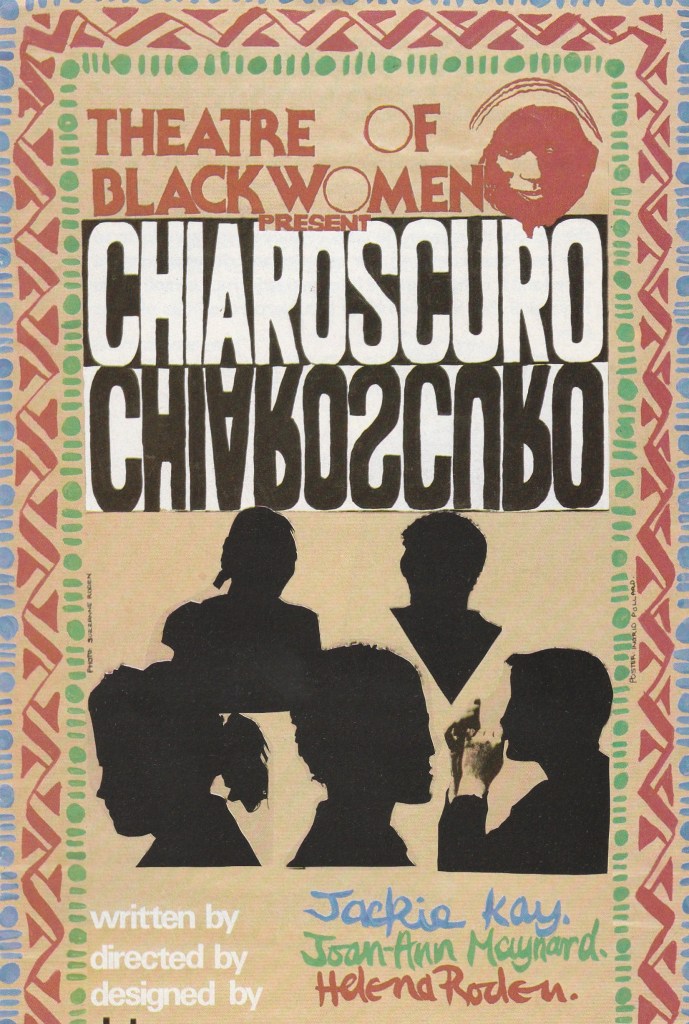
Sphinx / Theatre of Black Women
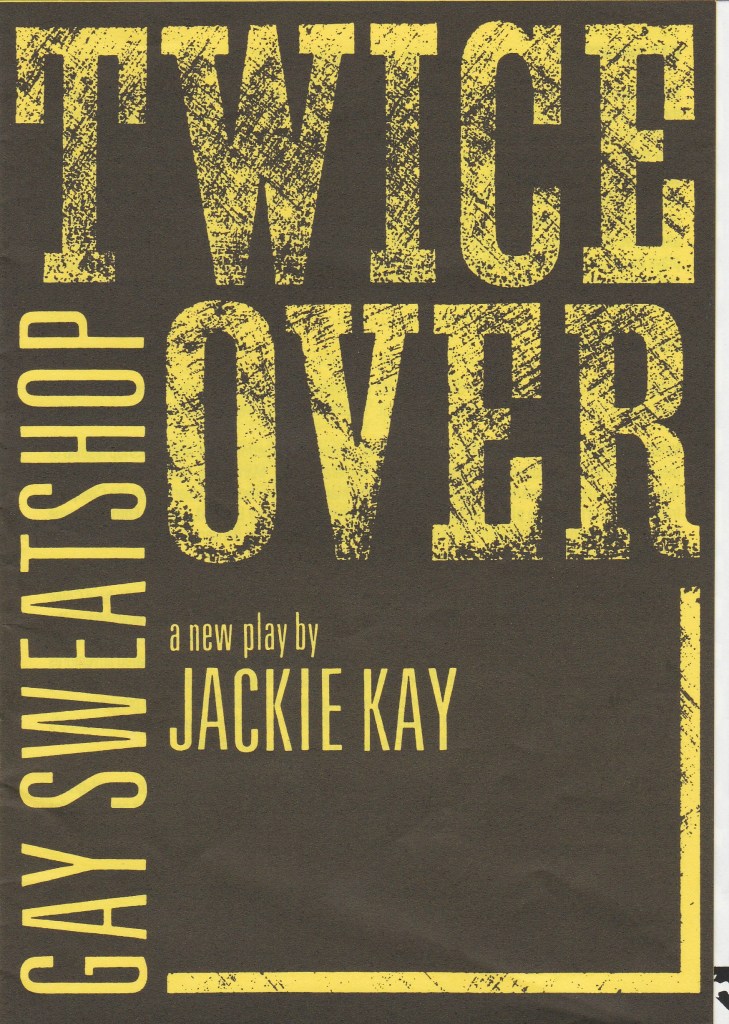
Gay Sweatshop
Moving along to the 1970s, there was the rise of fringe theatre itself which included the feminist theatre study group. In 1973 we saw the beginning of the Women’s Theatre Group which later became Sphinx. Theatre of Black Women was founded in 1982 by Bernadine Evaristo, Patricia Hilaire and Paulette Randall. There was also Monstrous Regiment and Gay Sweatshop which were mixed groups, the former being a mixed feminist group, the latter being a mixed gay and lesbian group, mostly gay actually.
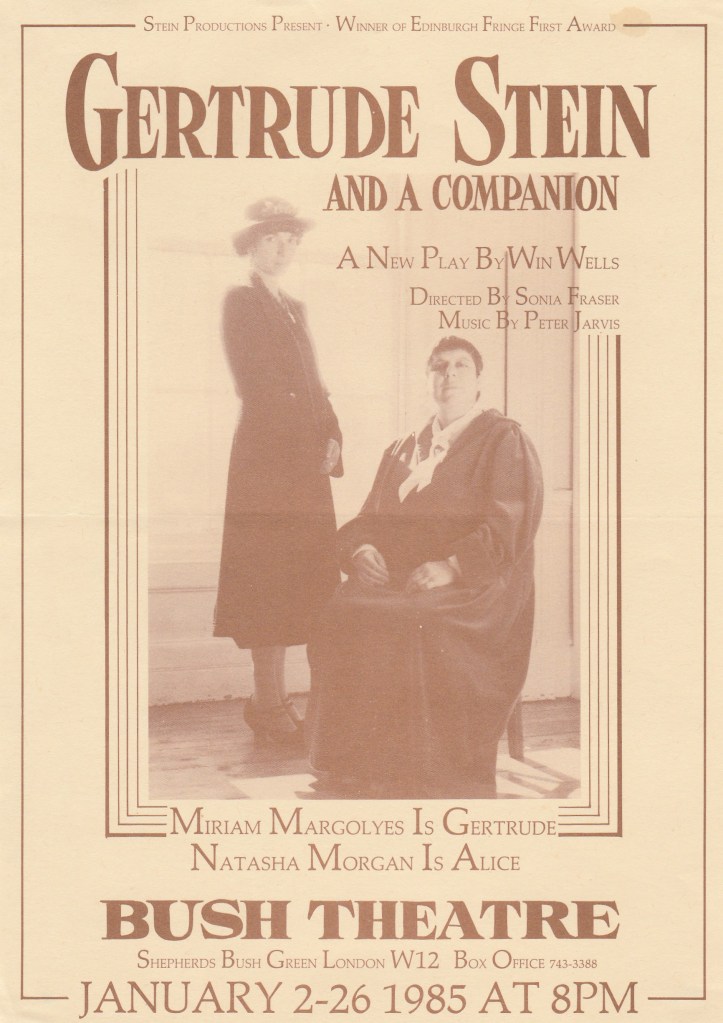
Gertrude Stein and a Companion
Lesbian theatre groups abounded. A lesbian feminist play could be a play that was written by a lesbian or about lesbians or preferably both, preferably also acted by lesbians, with themes around coming out such as Any Woman Can from 1976, which in its first one-night performance in Leicester starred Miriam Margolyles, seen in this slide in another play, Gertrude Stein and a Companion – and Jackie Kay’s Twice Over at the Drill Hall in 1988.
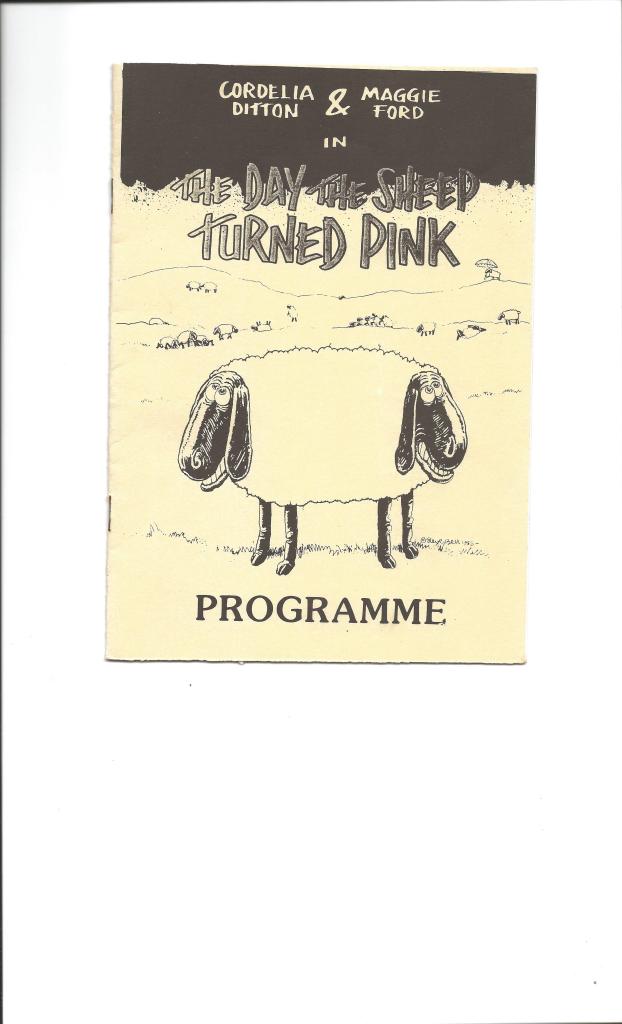
The Day the Sheep Turned Pink
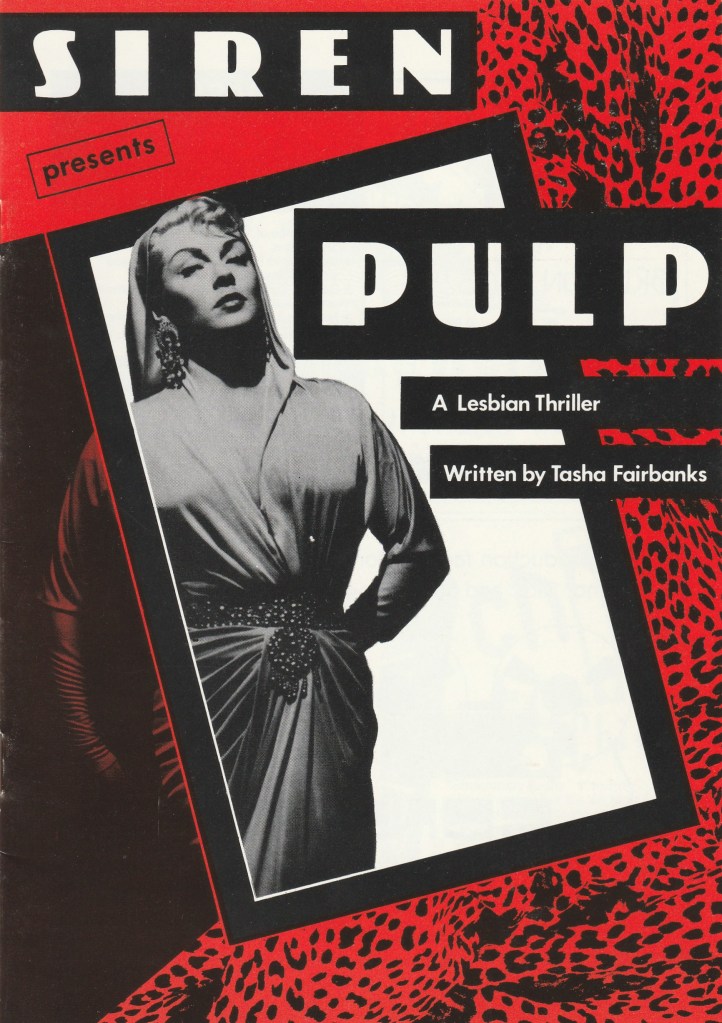
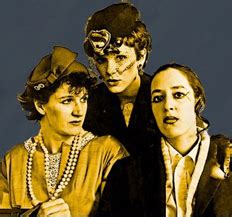
Pulp by Siren
Another theme was lesbian mothers, including about custody, such as Care and Control by Michelene Wandor. Very often plays were comic, spoofs set in the lesbian community. Or they might address wider serious issues such as nuclear disaster: The Day the Sheep Turned Pink by Cordelia Ditton and Maggie Ford; or male violence – 1981 Curfew by Siren. Another play by them was Pulp.
Cinderella
Peter Pan
The Drill Hall was famed for lesbian pantos. Nona Sheppard and Bryony Lavery featured large. These will be covered later in Val’s talk.
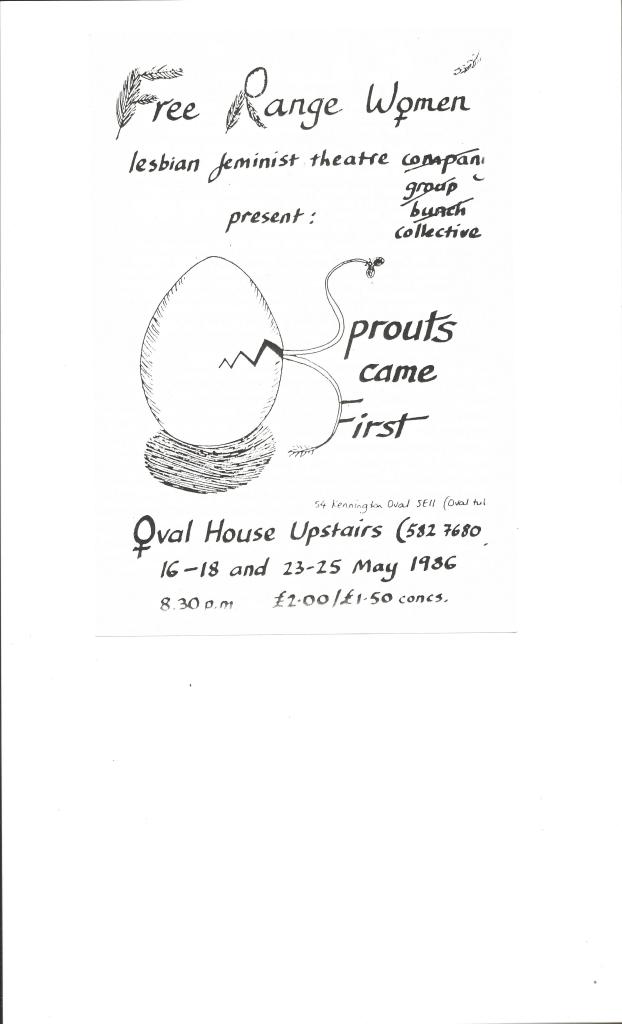
Sprouts Came First
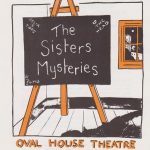
Another important venue was the Oval House, in Kennington, which Kate Crutchley ran in the 80s. Lots of the plays of these groups were put on there, including our play Sprouts Came First. Kate was one of my mentors, was incredibly supportive to the development of dyke theatre. It’s also worth mentioning the GLC (Greater London Council) here because they also offered a lot of resources to the community to express ourselves culturally. Also the Arts Council.
To briefly mention some of the groups that came along in the 80s that were either lesbian or followed by lesbians:
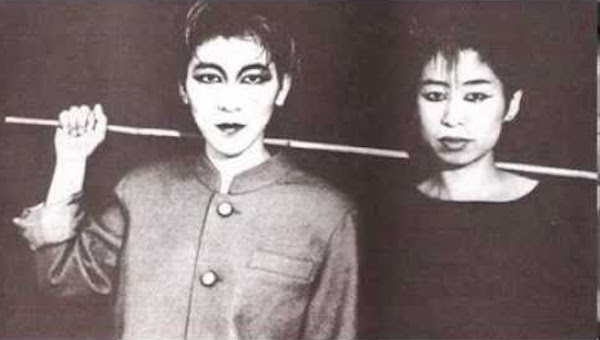
Frank Chickens started in 1982 as a duo of Kazuko Hohki and Kazumi Taguchi
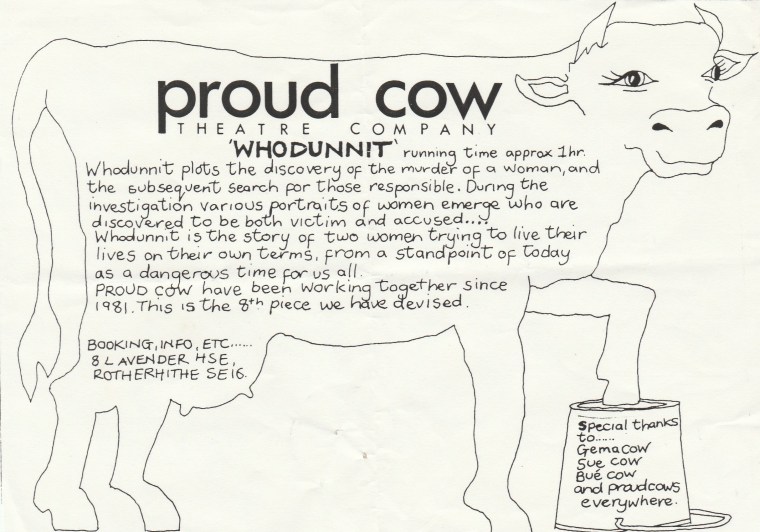
Proud Cow Theatre Company
Hormone Imbalance poster. Photo: Sue Jamieson
Character Ladies: Ladies of Llangollen, Death on Lesbos. This was Kate Crutchley’s own project
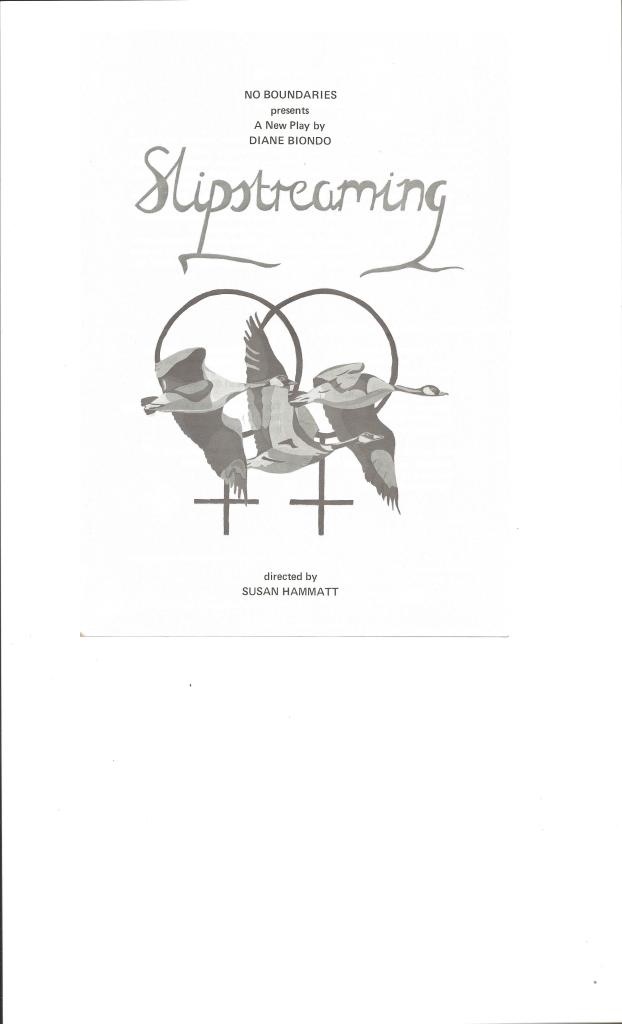
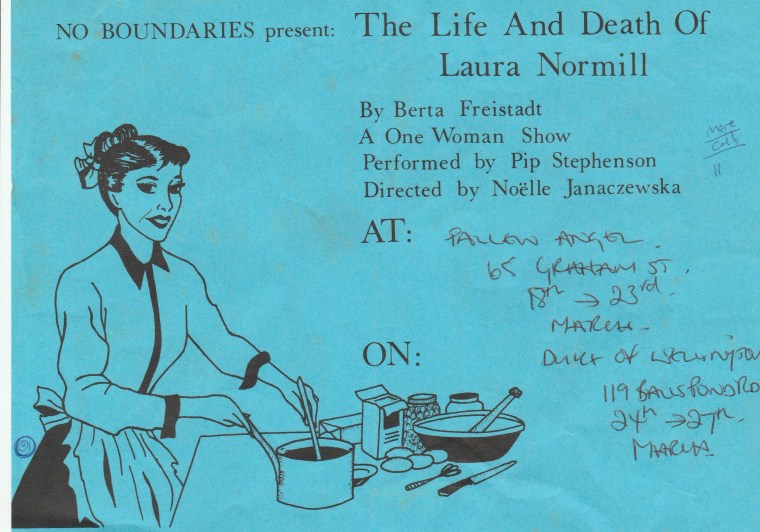
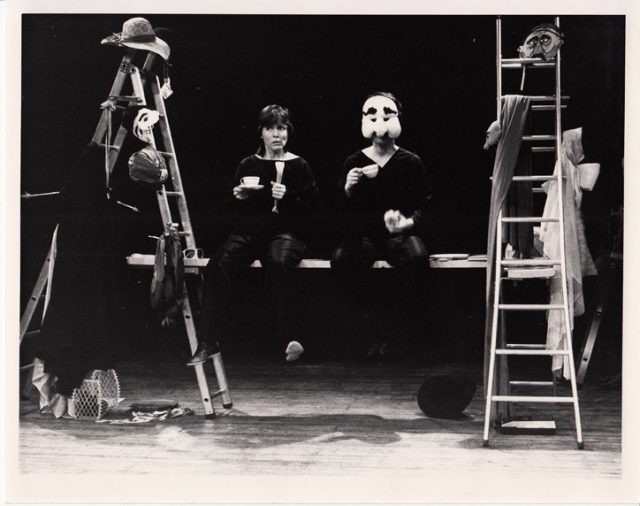
No Boundaries – Slipstreaming
Cunning Stunts collective 1977-82: circus and cabaret
Split Britches
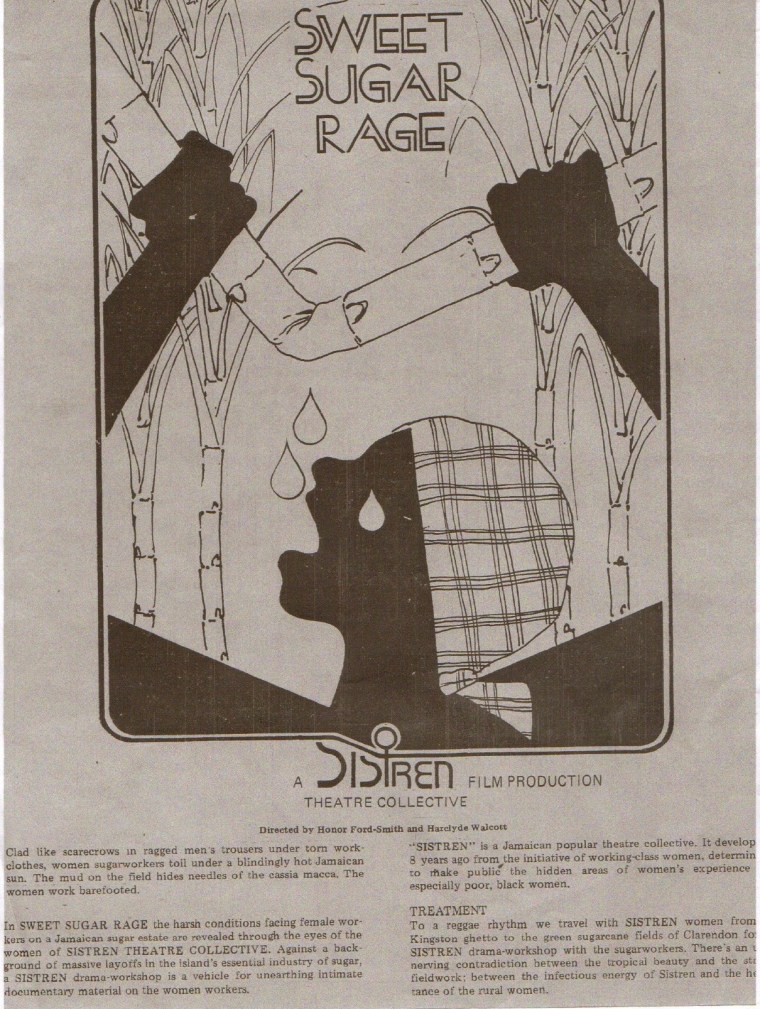
Sistren
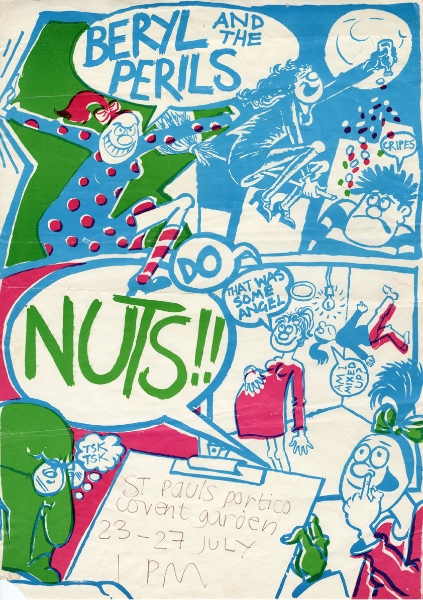
Beryl and the Perils
Berta Freistadt’s play The Life and Death of Laura Normill
Red Rag’s Ooh Missus
Topp Twins from New Zealand who were actually twins, and lesbians
Spare Tyre
Scarlet Harlets
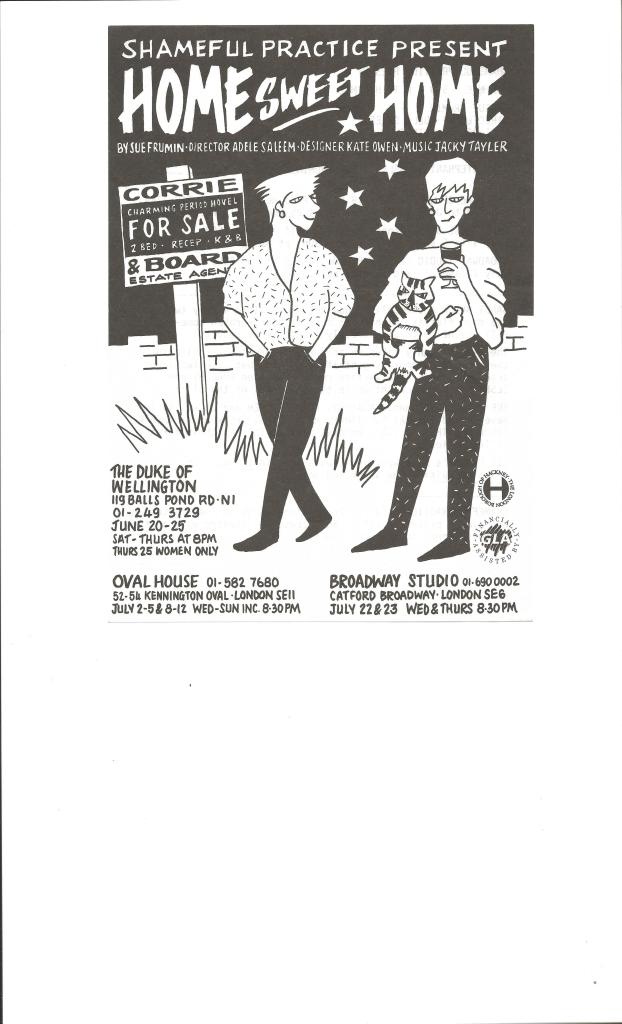
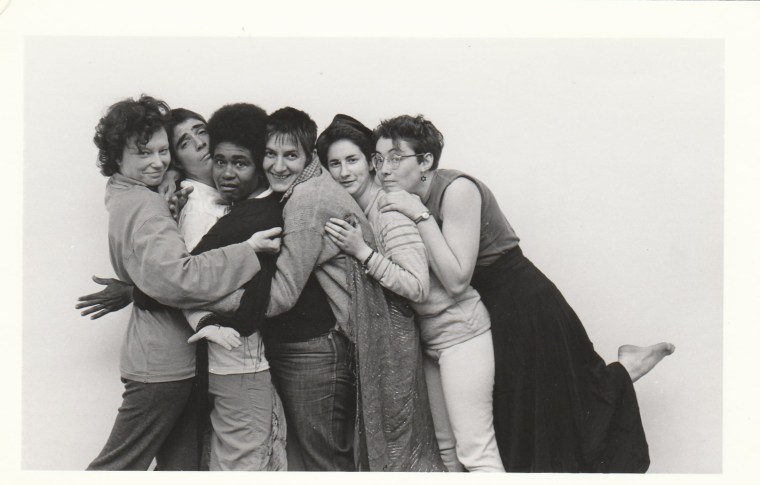
Shameful Practice
Berta Freistadt’s A Fine Undertaking, 1984, was a very funny parody set in a funeral home. And finally, Shameful Practice was a professional lesbian theatre company with a strong comedy element for all who need it.
That was loads of theatre!
Vole: “panto theory”
I have a theory.
Like many others of my generation, and probably other generations too, I wasn’t born into a lovingly, acceptingly lesbian environment. Most of us grow up alone, one of a kind, thinking There’s something wrong, I’m different, what’s the matter with me? One day, sooner or later, we realise.
But, growing up as lesbians in a straight world, we absorbed the images that surrounded us. If we even grew up in conditions where we had access to cultural artefacts, we might have heard those straight songs, seen those mainstream plays, and imagined ourselves replacing the male hero, rescuing the female character, running away from the world of men…
It’s been so rare for there to be a representation on the mainstream stage of a young lesbian realising who she is. When Alison Bechdel’s autobiographical graphic novel Fun Home was recently turned into a musical play, 10-year-old Alison sees a grown-up dyke in a cafe, and recognises that they have something in common. That this is the type of woman she could grow up to be. Her utter delight, and yearning, is beautifully captured in the song “Ring of Keys” – it’s the keys that this dyke wears on her belt as she swaggers up to the counter. The keys to Small Alison’s new world.
But for many of us, this never happened. For some of us, maybe it happened the other way round, much later on. As adults, we might go back to the stories, the dramas, the music that we grew up with, and we might re-run them, but this time with a lesbian sensibility. In our Fiddler on the Roof, or Fiddler in the Closet, Hodel might run off with a woman revolutionary.
The Sound of Music
For me, the funniest thing I ever saw, a moment of sheer delight, was the lesbian version of The Sound of Music at London Women’s Centre in 1991. I don’t have a programme or photos – it was staged in secret, because the tabloids had got hold of the fact that it was being illegally put on before the original version was out of copyright. The headline in the Sun was “Doh, a deer, a female queer”. (Boo, hiss). So all I have left is this mysterious ticket and the memory of lesbian Maria entering with her carpet bag and a big grin, on the way to become the new nanny for the children of whoever it was. I’m pretty sure the plot was based around the evil proponents of Clause 28.
For me, who had spent my childhood with a huge crush on Julie Andrews, as Maria, even as Mary Poppins for fucksake, it was like going back and seeing it all from the reverse viewpoint. Rewriting history into herstory: here was Maria and she was actually a dyke!
It would explain why I – and Zayeet, and others – love to rewrite those songs from musicals again and again. Why I choose to re-use those tunes that had so much significance for me then. It’s like rewriting our past to make it more ours, more authentically in keeping with our dykeliness.
In the discussion in the second half, please tell us if any of that resonates with you.
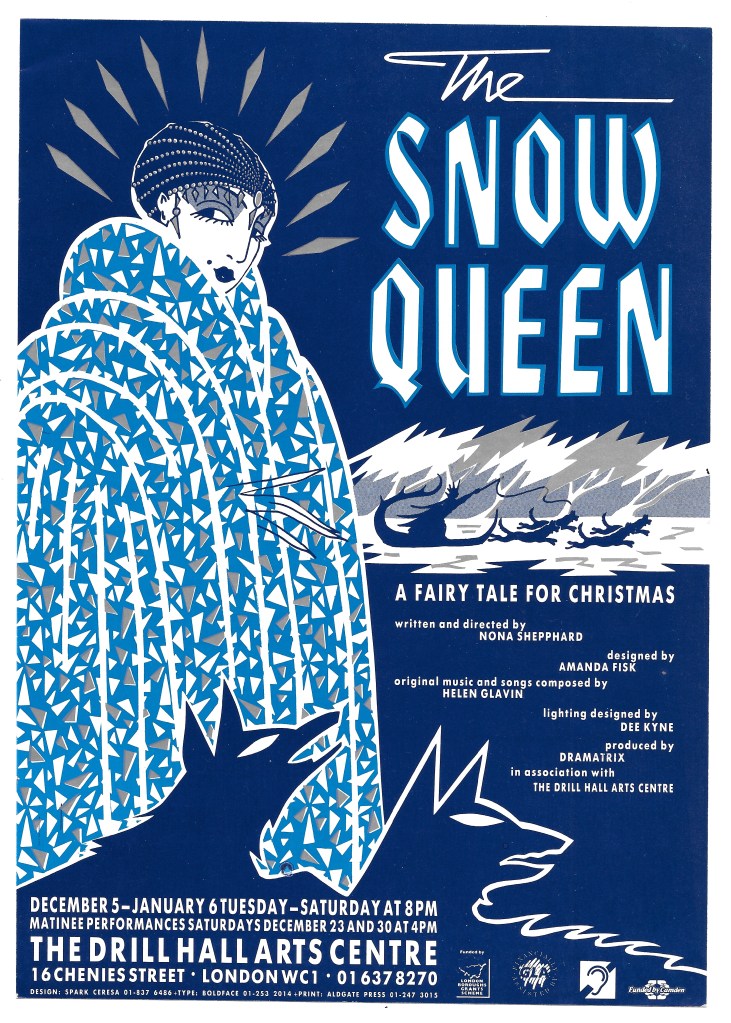
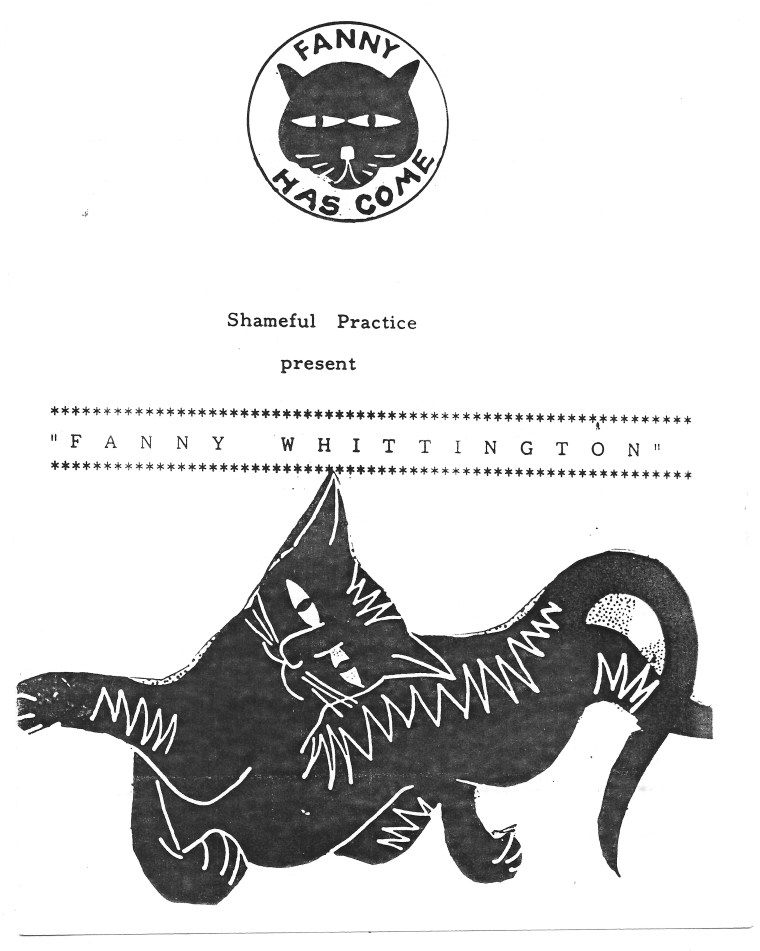
But the theory could explain why one of the most popular forms of lesbian feminist theatre I remember from the 80s and early 90s was the annual pantomime, usually at the Drill Hall. Pantomime wouldn’t have featured in everyone’s childhood – but many of us did enjoy those themes, those fairy stories, now re-run with a modern sensibility and a big helping of contemporary politics.
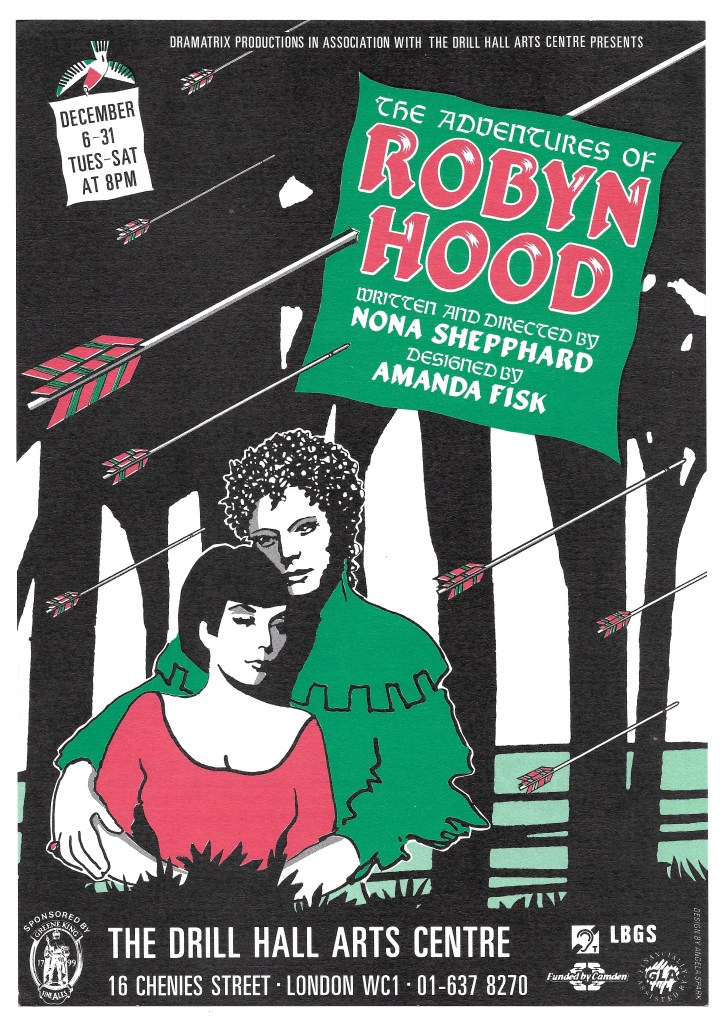
Robyn Hood
The Snow Queen
Fanny Whittington
Traditional panto already has the Principal Boy played by a woman, slapping her thigh as Robyn Hood or Cinderella’s Prince. The lesbian pantos took it further, making the same-sex attraction more overt, the power of those high-status characters more effective as female leaders of the plot. We audience members participated with enthusiasm, cheering, shouting “She’s behind you!” and singing along with the musical numbers – which were often very well-crafted by the likes of Laka Daisical, Jan Ponsford who wrote the music for Fanny Whittington and Helen Glavin.
Zayeet: about Free Range Women
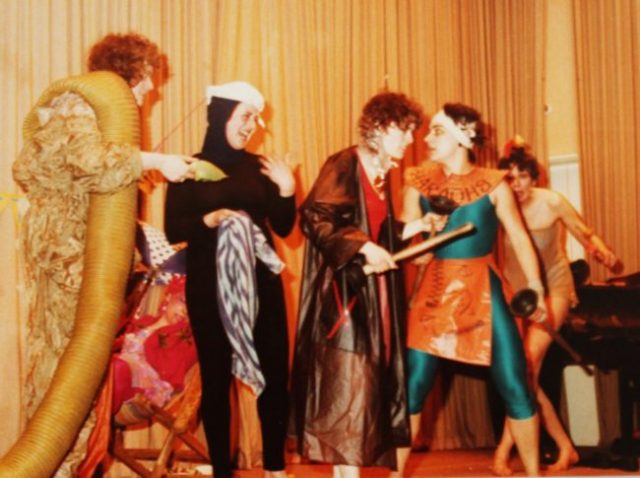
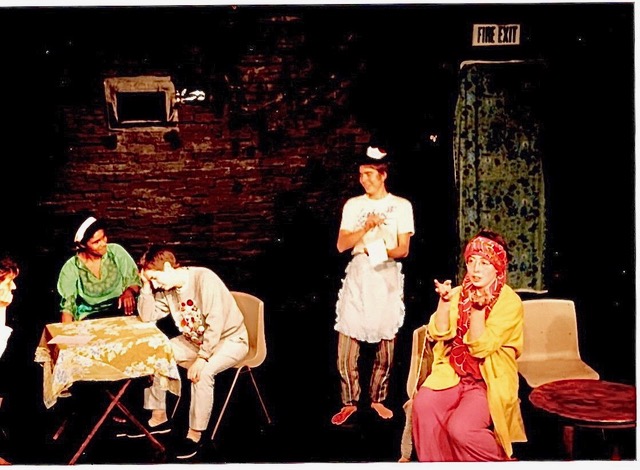
Coming on to our theatre company, Free Range Women and our play Sprouts Came First. It was a satire, or perhaps post-absurdist. After performing it for two weeks at Oval House Theatre, we repeated the play at Lauderdale House.
Free Range Women
Free Range Women
Ziza and her sprouter
Broken Heart Restaurant scene
We devised the piece together over a period of a few weeks. We each chose a kind of lesbian character/stereotype to portray. Iwas the narrator/foil/catalyst for the unfolding plot (if we can call it that), of a lesbian household and its meetings, meditations, collective living issues, like vegetarianism, love and relationships etc.
We also had a spiritual, goddessy-type character, and the others were three dykes who shared a flat in Deptford. One just wanted to go dancing every night, one was the nurturing cat-loving homebody, and Val here played Paula –
Vole: Paula… Tiklicorect!
Za: who was a full-time political activist. Meetings 24 hours a day, telling everyone what to do, and obsessing about what the US military were doing to the women at the Greenham Common peace camp. Destroying her own health in the process.
Vole: and given my penchant for musicals with really crap sexual politics, I found a song in Guys and Dolls which seemed to have potential for a bit of satire.
A lesbian can develop a cold
Vole:
“Lesbian Stress”?
 It says in this book:
 The average revolutionary lesbian
 Inevitably overbooked,
 After her millionth meeting may react
 With psychosomatic symptoms
 Not easily overlooked
 Affecting the upper respiratory tract.
 In other words, just from waiting around
 For that fucker to give up his hold
 A lesbian can develop a cold!

 You can feed her all day
 With the Vitamin A and the Bromofizz
 But the medicine never gets anywhere near
 Where the trouble is
 When she’s getting a kind of a name for herself
 And that name ain’t Ms
 A lesbian can develop a cold.

 The dyke remaining non-existent
 As far as society goes
 Shows a dramatic tendency, see note
 (Oh – see note)
 Chronic organic syndrome
 Pains in the fingers and toes
 And trouble with the ears and nose and throat
 In other words, just from worrying if the revolution is on or orff
 A lesbian can develop a cough

 You can spray her wherever you figure the streptococci lurk
 You can give every shot for whatever she’s got
 But it just don’t work
 When she’s tired of being solicited by her solicitor’s clerk
 A lesbian can develop a cough

 And furthermore, just from stalling and stalling
 Each action and march and trip
 A lesbian can develop la grippe
 When they get on the train for Westminster
 To protest some MP’s crime
 They’ve got all the banners and placards
 And the mood’s sublime
 But someone’s forgotten the leaflets
 For the fourteenth time -
 A lesbian can develop la grippe!
 La grippe – from a lack of a proper kip.
 With the wheezes and the sneezes
 And a sinus that’s really the pip
 From a lack of a regular income
 And a feeling she’s growing blue mould
 A lesbian can develop a bad, bad… [achoo]
Vole: Agitprop
In thinking about lesbian feminist theatre, it occurred to us that much of women’s political activity has an inherently theatrical aspect. There has certainly been a strong tradition of musical protest – using music, whether vocal or instrumental, on marches and demos, or making music itself the protest. An example of the latter – which shows the crossover between feminism and the peace/anti-nuclear movement – is Camilla Cancantata’s choral piece Trident: A British War Crime, which we staged as a singing flashmob in the Scottish High Court in Edinburgh in 2004.
With protest as theatre, one striking example – again anti-nuclear weapons – was the Greenham Common Women’s Peace Camp. The mass Embrace the Base actions, the dancing on the silos, the decorating of the fence, the confrontations with the police and the locals all had a theatrical aspect – visual symbolism being used to draw attention to the enormity of the threat posed by nuclear weapons.
And of course there is the music of Greenham – the many beautiful, or raucous, songs written there, or shared there. Our friend Paula Boulton has been archiving them and teaches them in workshops all round the country. Remember that Greenham was the cauldron into which many women jumped and emerged as lesbian feminists.
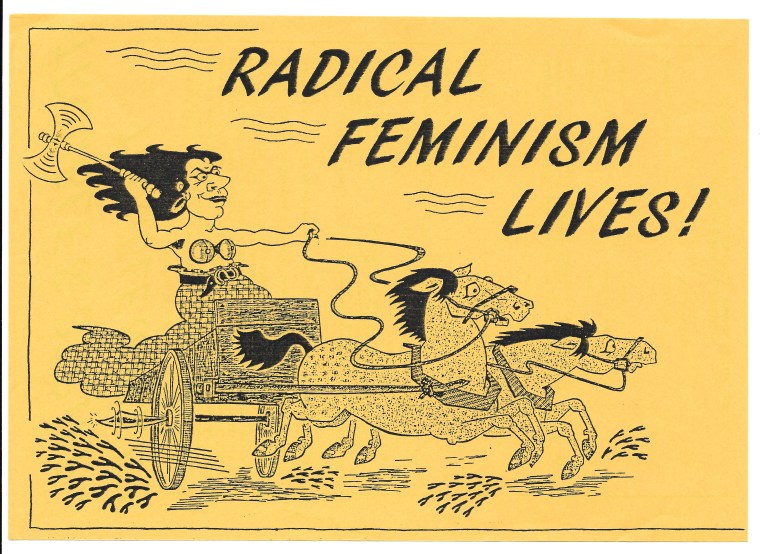
Boadicea: Radical feminism lives!
Going back to the seventies, thinking of strikingly theatrical feminist actions, we remembered the 1970 Miss World contest where Women’s Liberation activists flour-bombed the stage, shouting the slogan “We’re not beautiful, we’re not ugly, we’re angry!” I heard that they also released a troop of mice but I couldn’t find a reference for that. (An audience member confirmed that this was apocryphal.)
And then forward to the late eighties with Thatcher’s introduction of Clause 28, a.k.a. Section 28, of the Local Government Act [the one in which lesbians and gay men were described as promoting homosexuality and “pretend families”]. The many L & G actions against Clause 28 included dykes bravely abseiling into the House of Lords [from the gallery], and attempting to take over the BBC Six O’Clock News [on 23 May 1988]. My friend Kirsten Hearn wrote a song to immortalise that – “Nicholas Witchell / Is all of a twitchell / With dykes chained to his desk”.
One of Claudia Clare’s Clause 28 pots
And some women, myself included, invaded a show home at the Ideal Home Exhibition and hung banners from the windows saying “Lesbians aren’t pretending”. The only surviving record of that action brings in another artform – Claudia Clare, one of the invaders, immortalised it in pottery.
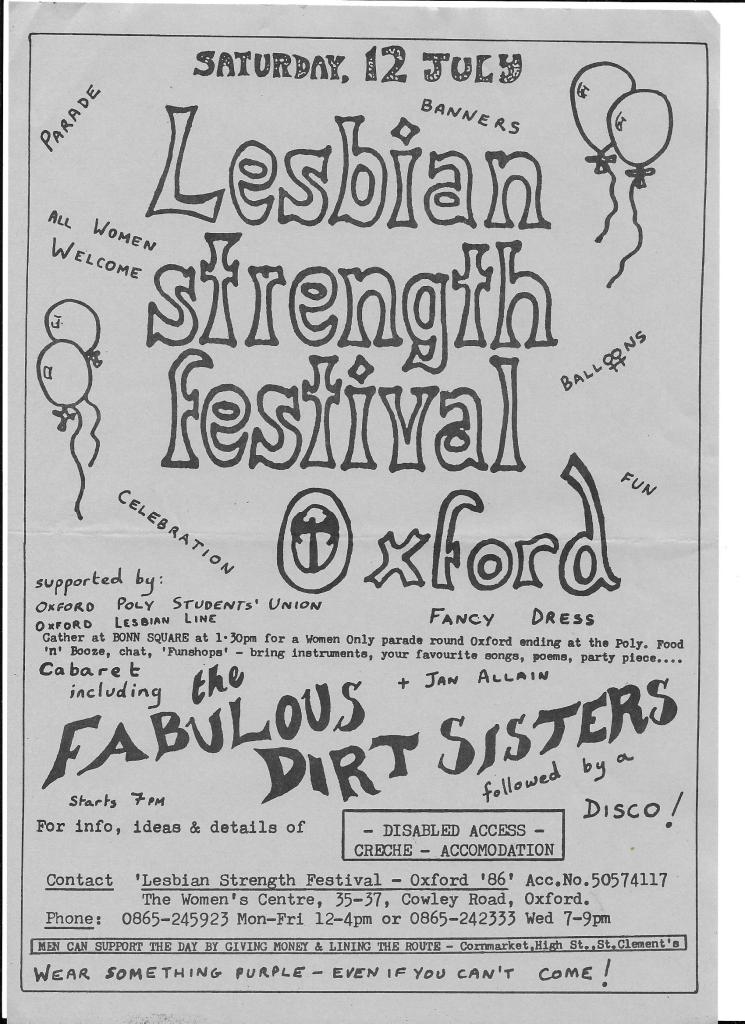
Oxford Lesbian Strength 1986
Lesbian Strength marches often included a cabaret and disco afterwards – I was involved in organising (and performing in) some of the cabarets in London, and Free Range Women performed after the Oxford Lesbian Strength march in 1986.
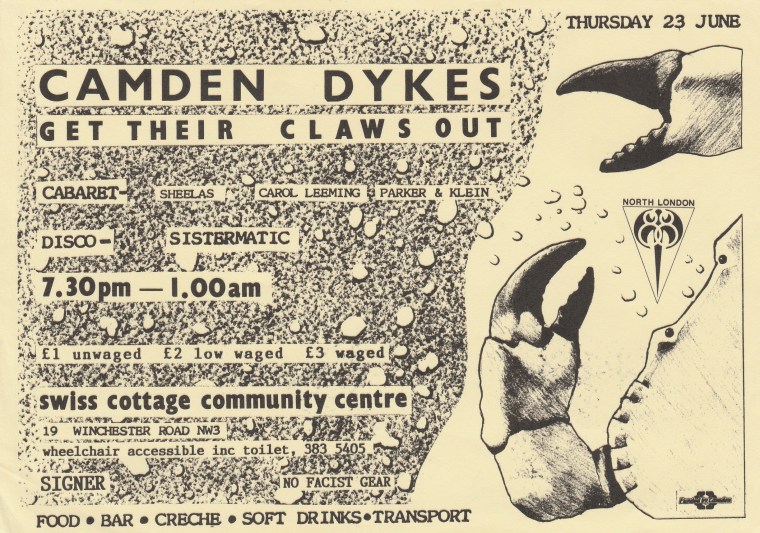
Camden Dykes Get their Claws Out
Slide 4, not shown on the day, indicates some of the creativity and irony that was used by lesbians responding to government/patriarchal oppression: there were a number of events whose titles referenced Clause 28. This slide showed a cabaret called “Camden Dykes Get their Claws Out” with a picture of a crab; I organised a poetry reading called “All the Nice Girls Love an Abseiler” along with Berta Freistadt and Eve Featherstone.
There was a musical entertainment as well as the political speeches at this year’s Lesbian Strength march in Leeds.
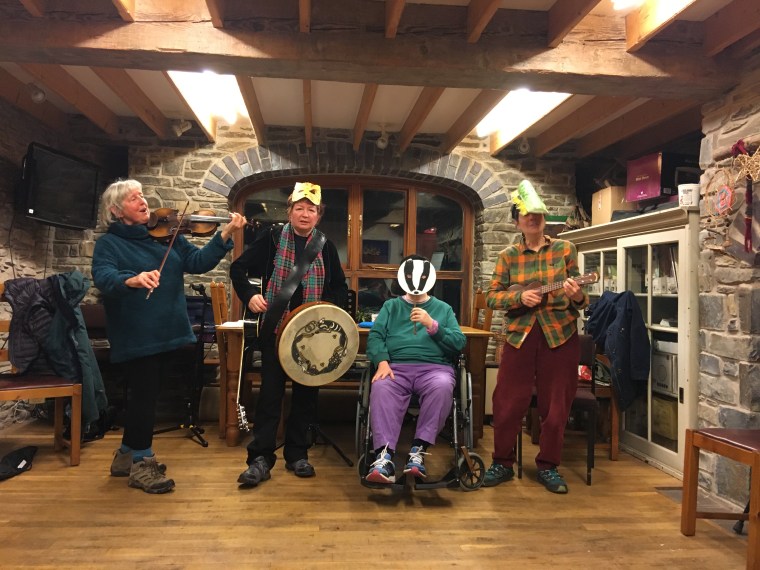
Keep Earth Company (KECo)
KECo playing at Denmark Farm
Zayeet: Our latest theatre collective, Keep Earth Company, grew out of a lesbian gathering we attended in West Yorkshire in August 2018. At the planning session, asked for suggestions of workshops and activities I suggested creating a play. Another woman wanted to run a song-writing workshop. So we joined forces and with interested women devised a musical. We combined our passion for animal spirits, mycorrhizal networks of trees, and finding a frequency to end patriarchy.
The members of Keep Earth Company live too far from each other to meet often, so we are now a loose sisterhood. If anyone would like to get involved, let us know and we’ll fill you in on how we operate now to keep to our shared direction.
Vole: Our colleague Paula says that she organised the open mic evening at FiLia last month and the performers who came forward were 90% lesbians. Song, drama, comedy, poetry were all represented. She feels that there is a clear thirst for lesbian culture.
KECo rehearsing at Denmark Farm
Here’s one of the songs we wrote together as KECo:
OUR RESISTANCE (short version)
In my ears the words of women
 Sapphic sisters sowing seeds
 From forever to forever
 Telling, telling, telling of our resistance, our resistance
 Women’s circles, rings of mushrooms
 Touch my bones and sing my spirit
 We will never be forgotten
 Someone will remember our existence, our existence

 (Listen, listen, listen…)

 Life force thrumming through the networks
 Power drumming underground
 Sounds of Sapphic sisters singing
 Listen to the song of our resistance, our resistance

 REPEAT last 4 lines, ending with
 Listen to the song of our resistance, our resistance, our resistance!
Bibliography: LESBIAN FEMINIST THEATRE
Methuen Drama Book of Suffrage Plays
Putting Your Daughters on the Stage: lesbian theatre from the 1970s to the 1990s, Sandra Freeman
Lesbian Playwrights in Britain, Rose Collis
The Cambridge Paperback Guide to Theatre, Sarah Stanton and Martin Banham (see lesbian theatre entry)
Contemporary Feminist Theatres: To Each Her Own, Lizbeth Goodman















 Lesbian History Group